The Antique Co
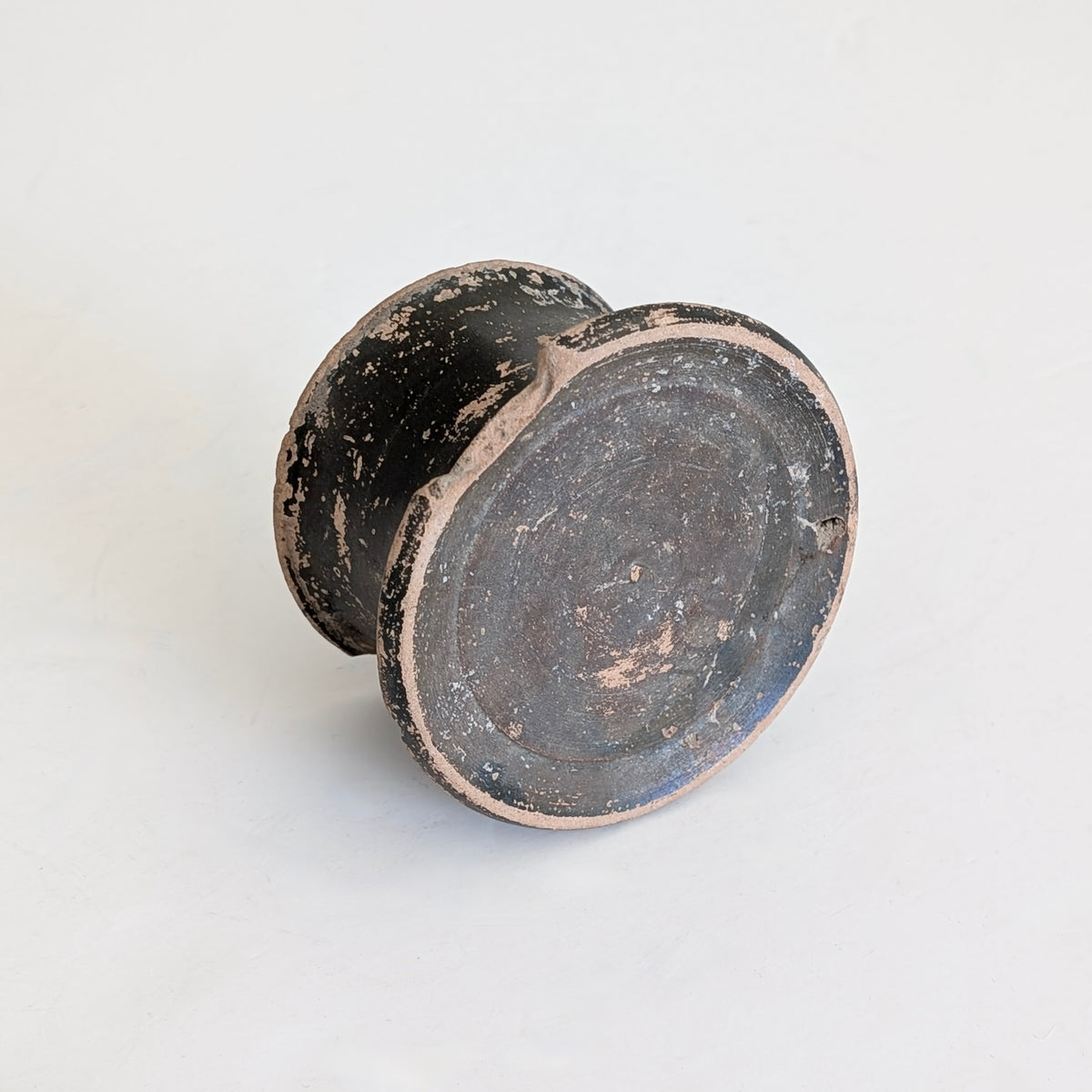
An Ancient Roman Republic Black Glazed Pyxis, Campania, Italy circa 200 BC
An Ancient Roman Republic Black Glazed Pyxis, Campania, Italy circa 200 BC
Couldn't load pickup availability
A rare Roman Republican wheel-thrown black-glazed ceramic pyxis, dating to circa 200 BC, from Campania, Southern Italy. Intended for the individual consumption of liquids, the vessel features an outward-flaring rim, concave profile and low ring foot. Formed from homogeneous beige clay, it is finished with a thick, iridescent black glaze displaying a distinctive metallic sheen.
Classification: "Campanian B pottery" according to the studies and research of pioneering archaelogist Nino Lamboglia and J. P. Morel. The item having a beige or pinkish clay fabric with black glaze displaying bluish and olive-coloured metallic reflections. Campanian B (form Lamboglia 3) corresponds to Morel types 7510, 7520, 7530, 7540 and 7550, including their respective variants. This is a vessel characteristic of the advanced phase of production, although it is also found in archaeological contexts dated between the second half of the 2nd century BC and the mid- or third quarter of the 1st century BC.
Measurements: The vessel measures 6cm high x 9.2cm wide at the foot.
Condition: In original found condition, displaying evident chipping, areas of glaze loss and surface encrustations consistent with prolonged burial.
Provenance: From the Terrence Lane Collection: Lane, a former senior curator of Australian Art at the National Gallery of Victoria in Melbourne, amassed the collection over 20 years.
Technological Analysis: How we can date and categorise South Italian pottery;
Scanning electron microscopy (SEM) reveals that Campana C pottery exhibits thicker, less sintered slips than the well-vitrified coatings of Campana A and B. Grey-slipped wares with grey bodies display notably thin, well-vitrified surfaces. Energy-dispersive X-ray (EDX) analysis indicates that the slips are enriched in aluminium and iron, but depleted in silicon and calcium relative to the ceramic bodies. Elevated potassium levels are present in most coatings, while Campana A exhibits comparatively higher sodium content. Thermal expansion measurements and X-ray powder diffraction suggest that firing temperatures generally exceeded 900°C, although some Campana C examples may have been fired below 800°C.
Certificate of Authenticity included.
Share